Where geometry trips students up, and how we fix it
The same five walls show up in NJ honors and college-prep classrooms alike.
 01
01
Two-column proofs and the reasoning column
What it looks like: Your child can see that a statement is true but cannot build the ordered argument that proves it. The statements column fills in; the reasons column stays blank or guesses.
How our tutors help: Our tutors teach proof as a game with rules: start from the given, name the one definition or theorem that licenses each step, then chain them. We practice short proofs to automaticity before long ones, so the logic becomes a habit instead of a mystery.
 02
02
Theorem overload and vocabulary
What it looks like: Alternate interior, corresponding, same-side, converse, contrapositive: the terms pile up and blur, and a problem that hinges on the right one becomes a coin flip.
How our tutors help: We organize the vocabulary into small families with a picture for each, then quiz retrieval in short bursts. When a student can see the angle relationship and name it, the theorems stop being a word list and start being tools.
 03
03
Algebra hiding inside coordinate geometry
What it looks like: Distance, midpoint, slope, and equations of lines drag old algebra back into the class, and rusty algebra costs points on problems the student otherwise understands.
How our tutors help: Our tutors repair the specific algebra each problem needs, right where it surfaces, so geometry does not become a second algebra failure. Keeping both skills alive at once is exactly what the NJGPA and the SAT reward.
 04
04
Seeing it: diagrams and auxiliary lines
What it looks like: Your child does not know where to start on a figure, cannot picture the rotation or the cross-section, and freezes when a proof needs an extra line drawn in.
How our tutors help: We teach students to mark up diagrams actively: label everything known, add the auxiliary line, redraw the 3D figure flat. Visualization is trainable, and a well-marked diagram often solves half the problem before any writing starts.
 05
05
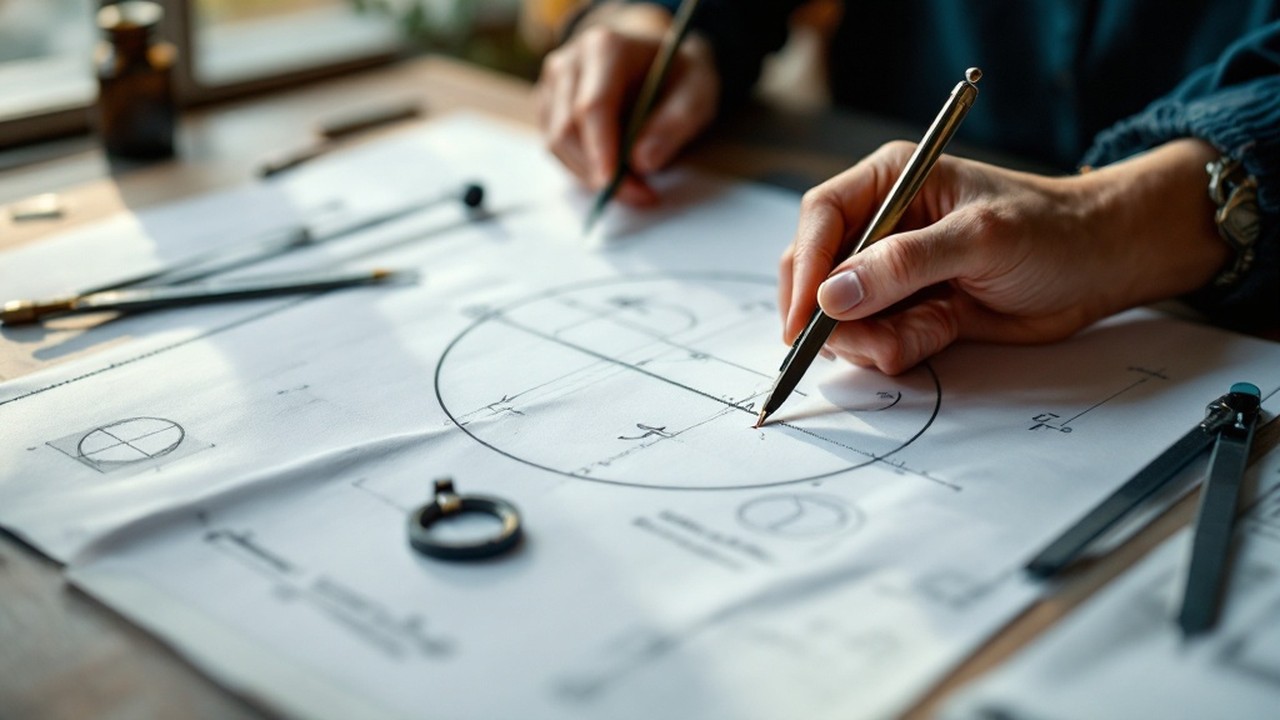
Constructions, transformations, and the test format
What it looks like: Compass-and-straightedge constructions and rigid transformations feel disconnected from the rest of the course, then reappear on unit tests and state assessments.
How our tutors help: Our tutors connect constructions to the definitions they illustrate and rehearse transformations as functions on coordinates, so these units reinforce the core course instead of feeling like detours.